
BOOMER LEGACY: FIGHTING
BOOMER LEGACY

Boomers and Friends,
We moved from Frankfurt, Germany to La Jolla, CA when I was almost four years old. I was an entirely shy young boy who knew absolutely nothing about life in America. I remember telling my mother that I was five years old as she escorted me to my first day at La Jolla Elementary School. She corrected me, telling me that I was four years old but would be five years old in a week. I told her four was not old enough to go to school, so I must be five.
One day in third grade I was standing around with a small group of kids during lunch break. One of the kids was a cute girl that I was timidly admiring. I wanted to talk to her, but I was too shy. Suddenly a guy named David marched up to us. He cornered the boys, pointed to the girl, and spit out a warning that he would punch any boy who said he liked her.
He repeated his threat a few times while he towered over us. “You can’t do that. It’s wrong.” I said in a whisper. No one else dared to say anything, and he continued to threaten with his face right in mine. Finally he turned and started to walk away.
Without warning the words “I like her!” leapt out of my mouth. True to his threats he turned quickly, marched up and walloped me in the stomach. I bent over, failing to hold back my tears. I was direly embarrassed from head to toe. “I told you!” He said.“I warned you!” Then he looked around and marched off. The girl and the other boys had run off. I was deserted, saddled with my first lesson in bullies and what getting punched felt like—and what kinds of bad things can happen at school.
To this day I don’t know what got into me. Apparently a cute girl had motivated me to talk back to the bully. It wasn’t the last time my admiration of a girl would get me into trouble with a guy who wanted to fight about it.
In fourth grade, I was leaving school one afternoon when I noticed that a lot of kids were running up the street toward a crowd. I stopped a kid and asked him what was going on. “Girl Fight” he bellowed, then he ran off toward the crowd which had spilled out onto the street.
It seemed like half the school was there. It was along my route home so I walked up until I got to the crowd. I hesitated for a while, but my curiosity got the better of me and I wedged my way through the crowd to where I could see what was going on.
Two girls were screaming at each other, pulling hair, ripping at clothes, throwing purses, books, and whatever was in reach at each other. When they were close enough to each other they threw fists. It was a serious fight, and an ugly spectacle. Kids in the crowd were screaming support for one or the other.
The girls were older than I was. I figured they were in 5th or 6th grade, and I didn’t know either of them. What could possibly create all this anger I was seeing and hearing, and why were all these kids yelling? I’d never seen anything like this before. It was a weird, shocking incongruity. The ugliness of the crowd gave me a sickish feeling, so I turned back and wormed my way out.
As I turned down Genter Street a car drove right up to the crowd. I looked back and watched a woman get out and push her way through the chaos to get to the girls. I figured she must have been the mother of one of them. This gave me some feeling of relief. I told my mom all about it when she got home from work.
I started watching sports on TV at my cousin’s house, primarily professional baseball and football, yet the sporting event that stands out the most in my memory from early childhood is the Cassius Clay-Sonny Liston fight in February 1964.
I was eight years old when the fight took place. I didn’t even know that boxing was a sport until about a week before the match, and I have no idea why I was interested in it except that everyone, kids at school, dads, my cousins, and my uncle were all talking about it.
There was a lot of TV and radio commentary leading up to the match. I heard Cassius Clay (later, Muhammad Ali) bragging on the radio and decided I didn’t like him. Sonny Liston was the reigning champion, so I decided to root for him.
Listening to the fight on the radio had me unusually excited. The announcer reported every round of blows and counter blows. It was a fast moving sport, exciting, and way different than baseball or football. The announcer never stopped jabbering, even between the rounds.
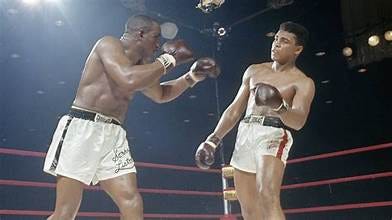
I began to get discouraged when Sonny Liston started losing. He was bleeding a lot, and he finally had to concede the fight. When Cassius Clay was declared the winner he grabbed the announcer’s microphone and proceeded to carry on and 0n for all the whole world to hear and see, breaking all the rules of behavior I was being raised with.
I was appalled and embarrassed by the spectacle, and that was the end of my interest in boxing because Clay/Ali dominated the sport and kept his title for several years. Baseball, football, and basketball became my sports, and eventually I played in all three at school and in public leagues.
******
The war in Vietnam began in earnest when I was in 4th grade and did not completely end until my second year in college. The United States entered the war progressively, in a series of steps between 1950 and 1965. In May of 1950, President Harry Truman authorized a reserved program of economic and military aid to the French, who were fighting to sustain control of their Indochina colony, including Laos and Cambodia as well as Vietnam.
When the Vietnamese Nationalist (and Communist‐led) Vietminh army defeated French forces at Dienbienphu in 1954, the French were forced to assent to the creation of a Communist Vietnam north of the 17th parallel while leaving a non‐Communist entity south of the line.
Lyndon Johnson fully committed the US to the war. In August 1964, he secured from Congress a functional (not actual) declaration of war: the Tonkin Gulf Resolution. Then, in February and March 1965, Johnson authorized the sustained bombing, by U.S. aircraft, of north of the 17th parallel targets, and on March 8th sent 3,500 Marines to South Vietnam.
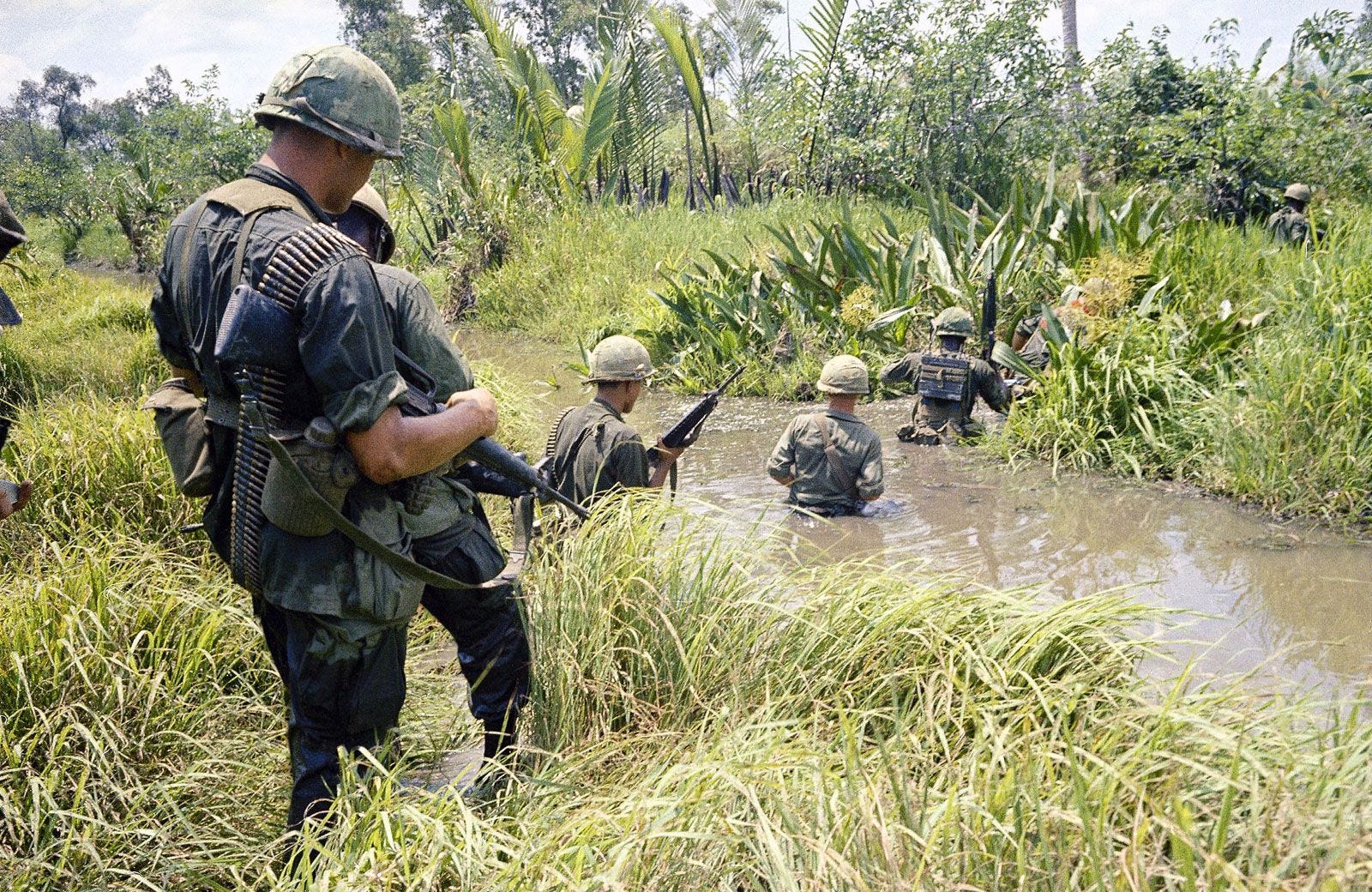
The number of U.S. troops increased by degrees until it hit a peak of 543,400 in April 1969. The total number of Americans who served in South Vietnam was 2.7 million. More than 58,000 died or remained missing, and 300,000 others were wounded. The U.S. government spent more than $140 billion on the war, an immense sum of money for the times.
While Vietcong guerrillas recorded military successes, leaders of Vietnam’s Buddhist majority protested against what they saw as the Diem regime’s religious persecution. A monk dramatically lit himself on fire and expired at a busy Saigon intersection, an act shown repeatedly on TV for years following his act of protest.
On August 7th 1964, Johnson secured almost unanimous consent from Congress for his Gulf of Tonkin Resolution, which became the principal legislative basis for all subsequent military deployment in Southeast Asia.
In 1965, U.S. aircraft flew 25,000 sorties against North Vietnam, and that number grew to 79,000 in 1966 and 108,000 in 1967. Targets expanded to include the Ho Chi Minh Trail in Laos and factories, farms, and railroads in North Vietnam.
Monthly U.S. draft calls increased from 17,000 to 35,000 to meet manpower needs, and deficit spending, with its integral inflationary effect, funded the escalation.
In the early morning of the 30th of January 1968, Vietcong forces launched the Tet Offensive, named for the Vietnamese holiday being celebrated. In coordinated attacks throughout South Vietnam, the Vietcong assaulted major urban areas and military installations in an attempt to ignite a popular revolt against the Saigon regime and its American backers.
The Tet Offensive was a great strategic gain for North Vietnam and its southern adherents. Most importantly, as a result of the massive surprise attack and the pictures from Saigon, the U.S. press and public began to challenge the Johnson administration’s assurances of success and to question the value of the progressively costly war.
Meanwhile, combat raged in South Vietnam. Over 14,000 Americans were killed in action in Vietnam in 1968, the highest annual U.S. death toll of the war. The worst U.S. war crime of the conflict occurred on March 16th 1968 (not revealed in the press until November 6th 1969) when American soldiers massacred some 500 subservient civilians in the village of My Lai.
Peace talks began in Paris on May 13th 1968 but immediately lost steam. When Richard Nixon became president in 1969, the U.S. war effort remained prodigious, but the basic decision to de‐escalate had already been reached. In June, the White House announced the first withdrawal of 25,000 U.S. troops.
The morale and discipline of U.S. troops relapsed in 1969 as the futility of the ground war and the beginning of U.S. withdrawal became more transparent. Survival of their twelve‐month tour of duty became the only motivation for many soldiers. Incidents of insubordination, mutiny, assaults on officers, drug use, racial tensions, and other grievous quandaries increased.
Over the course of the war, total U.S. bombing tonnage far exceeded that dropped on Germany, Italy, and Japan in World War II.
On January 27th 1973, the United States, North Vietnam, South Vietnam, and the Provisional Revolutionary Government representing the NLF signed the Paris Peace Treaty, ending the War and restoring Peace in Vietnam.
By April 1st 1973, U.S. forces were out of Vietnam (except for a few embassy guards and attaches) and 587 POWs had returned home. About 2,500 other Americans remained missing in action.
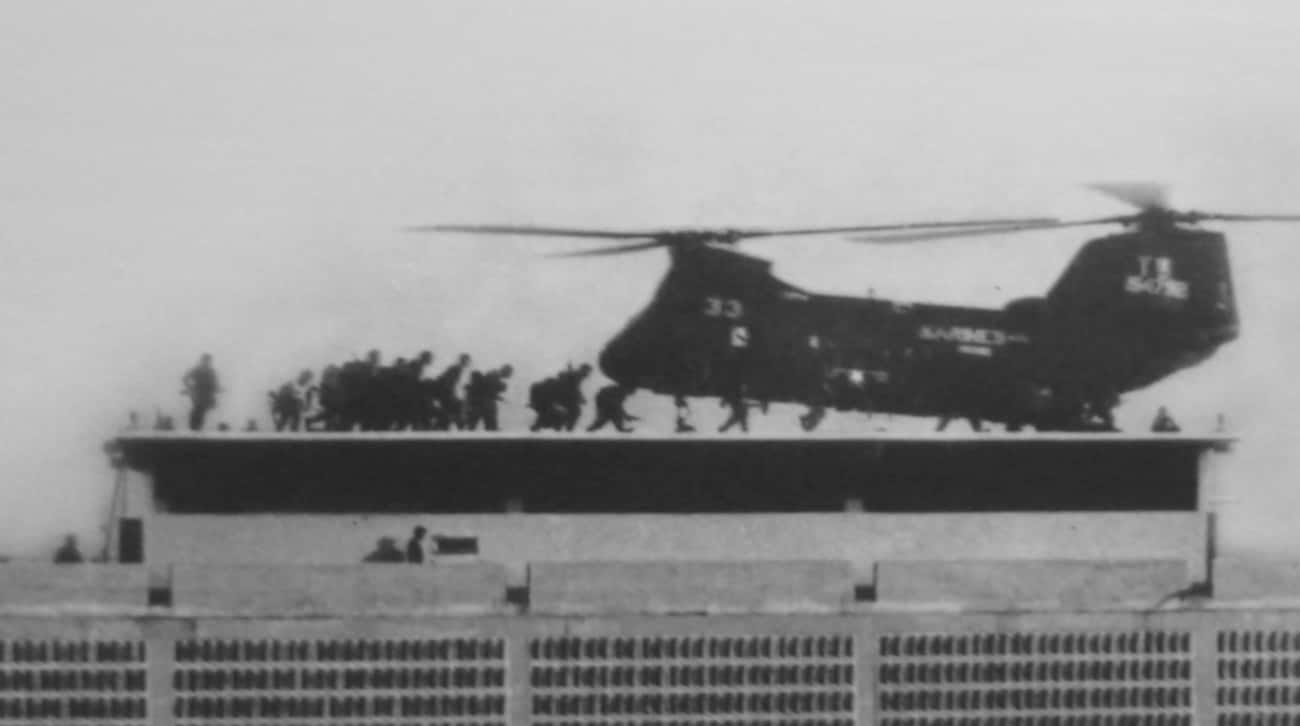
South Vietnam’s military defenses steadily deteriorated. In the spring of 1975, a NorthVietnamese Army thrust into the Central Highlands turned into a South Vietnam rout. On April 30th, as the North Vietnam Army and Vietcong soldiers entered the city, the last remaining Americans abandoned the U.S. embassy in Saigon in a dramatic rooftop evacuation by helicopter. It was a sad, demoralizing event for Americans who had staunchly held to the idea that the U.S. had never lost a war.
The United States failure in Vietnam raised significant questions. Should the United States have fought the war at all? Did the United States fight the war the wrong way? Many analysts believe that the strategic importance of Vietnam was vastly exaggerated. On the question of how the war was fought, the debate centers on whether the United States used its military power adequately and effectively. A larger war could have risked a dangerous military conflict with China and the USSR. Most scholars conclude that the Vietnam War was a tragic event whose costs far exceeded any benefits for the United States.
*****
1973, the year I graduated from high school, was the last year of the military draft. My birthdate was assigned number 141 which made me nervous for a while. I had a friend in my Life Science class named Frankie, and we would talk bullshit about running away to Canada if we were drafted. I can’t remember talking to anyone who said he was looking forward to serving in the military. Peace, Love, and Rock’n’Roll were the narratives of the day. Most kids at my high school were anti-war, anti-Vietnam.
Later in the year I was accepted at the Universities I had applied to, which exempted me from the draft as long as I was enrolled. I breathed a long, somber sigh of relief even though the Vietnam War had ended for the United States.
Buckle up Boomers and friends, overseas war and internal chaos in the United States loom before us every day. The Epstein revelations continue to stun and enrage.
I am current, engaged, ready for the next installation, university. …La Jolla, what a wonderland in which to have grown up!